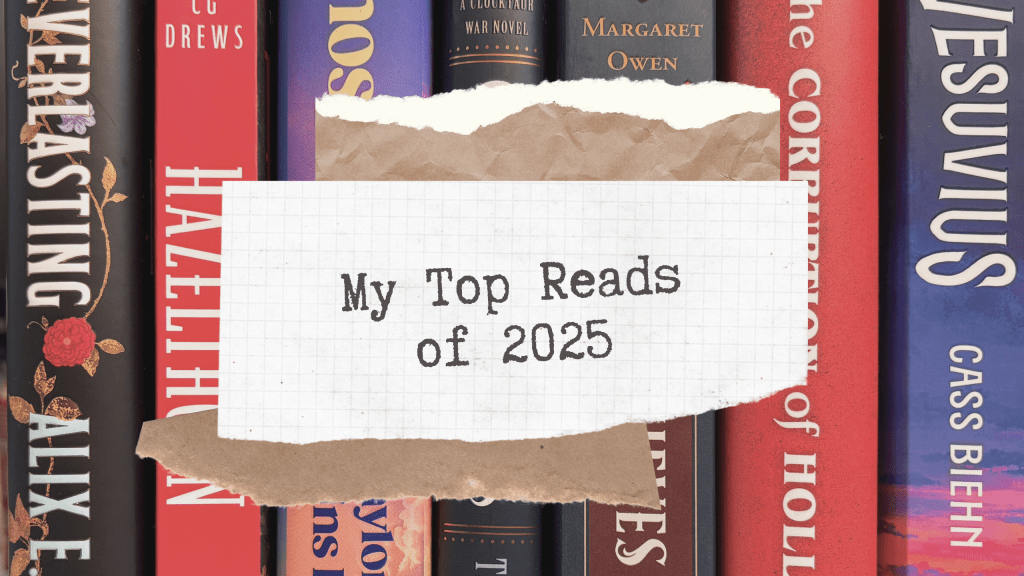

I’ve been reflecting on what I read in the past twelve months, and I want to spend a little more time talking about my favourite reads of the year and collecting those thoughts in one place. Some of these books have separate full reviews where I talk about my thoughts in a lot more detail than I will here, so I might be repeating myself.
I will admit that I started the year with fewer notable favourites than I usually do in the first half, but there were still a few, so I was holding out for the second half of the year to be five-star read after five-star read. I can now confirm that the second half of the year was not filled with five-star read after five-star read, but I did find a few new favourites.
This list will be in no particular order, just vaguely chronological, so let’s begin!
Vesuvius by Cass Biehn

Vesuvius is a queer young adult fantasy set in ancient Pompeii, featuring a cunning thief, a temple attendant, and a burning city. After Felix seizes an opportunity to steal a helmet in Pompeii, he discovers that it is not only a priceless artefact but a relic of the god Mercury. Pieces of his forgotten past begin to simmer when he touches it. Loren is plagued by nightmares of Pompeii’s destruction which grow clearer as the danger grows closer, and he knows they have days to uncover Felix’s ties to the relic and his own dreams if they have any hope of saving the city from the fury of Mount Vesuvius. But the city is ruled by bloody politics and unstoppable destinies, with dangerous, desperate people lurking in every shadow. Felix and Loren have to piece together their fates—and their growing feelings for one another—to make it out of the burning city alive.
There’s something about retellings and re-imaginings that I’m immensely fond of—these stories inspired by mythology and folklore and fairytales that litter my bookshelves—and it’s the fact that I often know how they’ll end. I enjoy the comfort of structure and routine, and I am someone who reads every spoiler about a film that I can find before I watch it, so the thing it takes to impress me in these books is the writing being so enthralling that I forget I already know about the ending. As readers, we know that Vesuvius will erupt, but we don’t know about the final days leading up to that inevitable moment, and I want those days to sweep me away from the tragedy.
Vesuvius is an atmospherically stunning debut for fans of immersive mythology reimaginings, tragedies where the characters spend the entire time trying to rewrite the ending, and broken boys trying to put themselves together again.
The Corruption of Hollis Brown by K. Ancrum
Hollis Brown is a queer romantic thriller featuring Hollis, a boy in search of meaning, and Walt, a spirit with unfinished business. Their lives collide when Walt takes possession of Hollis’s body…and maybe his heart. It’s a story about possession where the end goal is to fall in love with your possessor and protect your love rather than exorcise them, and it’s simultaneously a trauma-infused story about undoing a generational curse that turned their hometown from a place of hope to somewhere where dreams go to die. It’s a love letter to healing from trauma and to the importance of connection and empathy (as most Ancrum works are).

As usual, Ancrum’s sparse prose is the standout of her storytelling, an unconventionally small amount of words creating an immense impact, and I wish I had a physical copy to highlight every moment where a single phrase made me clutch at my hypothetical pearls. It’s beautifully written, and intimate, and poetic, and everything I want from such a vulnerable story. Ultimately, Hollis Brown is a book about falling in love with your demons and breaking generational curses, while still baking loaves of bread for your ‘food as a love language’ best friends along the way.
Little Thieves by Margaret Owen
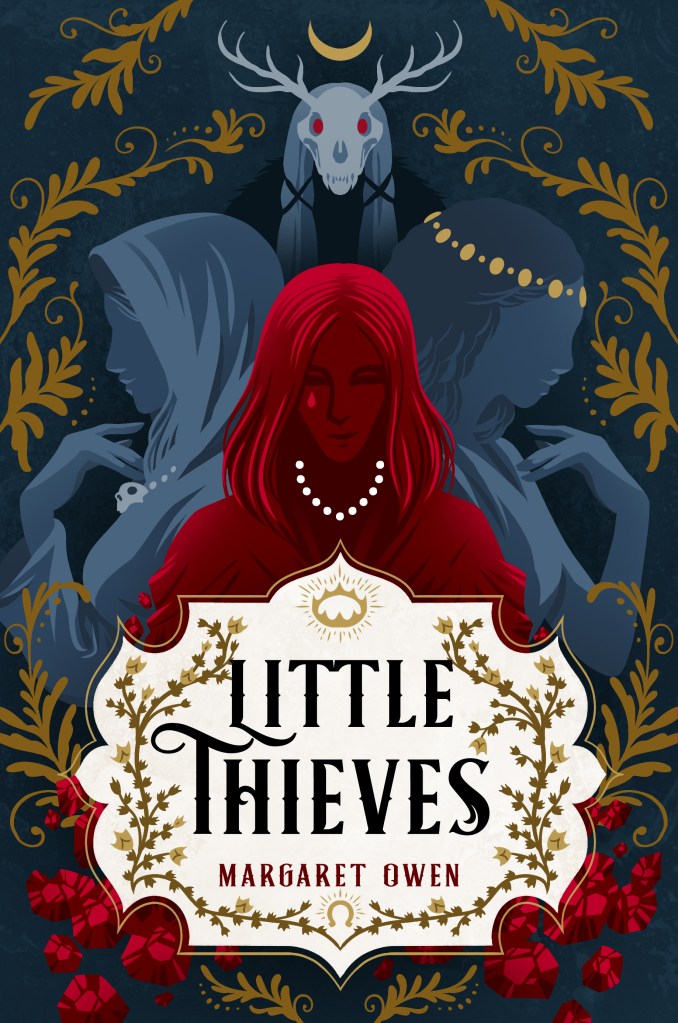
Once upon a time, there was a beautiful, kind princess who was betrothed to the prince of a faraway kingdom. When she set off for her new home, her mother gave her a maid for a companion on the journey. But instead of serving the princess, the wicked maid stole her place. For a year the true princess toiled away like a common goose girl, while the wicked maid lived high in the palace, fooling the kingdom. But the truth came out. The princess took back her name, her crown, and her husband, and the imposter died for her crimes. Then one day, the wicked maid told her own story.
I did not know what to expect from this book because 1) it’s a Goose Girl retelling, and I know nothing about The Goose Girl, and 2) the description truly says Nothing about what the plot actually unravels itself to be. But I fell in love with Vanja, the anti-heroine, immediately. She’s a bad person for the most part, and she constantly has conflicts thrown in her path, and they’re a whole lot of fun to read. Her story has a little bit of enemies-to-lovers romance sprinkled in, as well as reluctant friendships and a complex untangling of her feelings towards forgiveness and revenge.
The Clocktaur Duology by T. Kingfisher
When forger Slate is convicted of treason, she faces a death sentence. But her unique gift for sniffing out magic (literally) earns her a reprieve―of sorts. Along with a formerly demon-possessed paladin, her murderous ex-lover, and an irritating sexist scholar, Slate sets off on a mission to learn about the Clockwork Boys, deadly mechanical soldiers from a neighbouring kingdom who have been terrorising their lands. If they succeed, rewards and pardons await, but they must survive a long journey through enemy territory to reach Anuket City. But Slate and her crew aren’t the first to be sent on this mission. None of their predecessors have returned, and Slate can’t help but feel they’ve exchanged one death sentence for another.

I am counting both of these books as my favourite because I refuse to cave and pretend that what is very clearly one book split into two volumes is a real duology. However, I did prefer The Wonder Engine over Clockwork Boys, because Clockwork Boys cuts off right as the characters are about to enter the city, and we hit what I find to be the selling point of the plot, and it’s just incredibly unsatisfying as its own novel.
But they are incredibly satisfying read back-to-back as one complete, lengthy novel. I’ve read six T. Kingfisher books so far this year and loved all of them, just to make a point of how much I loved these ones to make them a favourite. I love her humour and wicked imagination, and how many of her characters have this deep kindness and intense humanity that comes with uncompromising views of right and wrong. The joy in these books is the growing friendships that happen despite themselves—you wouldn’t think that a rogue accountant, a possessed knight, an assassin, and a religious fanatic setting off on a classic fantasy quest slash suicide mission would have friendships and found family adjacent vibes as the selling point, but here we are.
Born for This by Caitlin Devlin
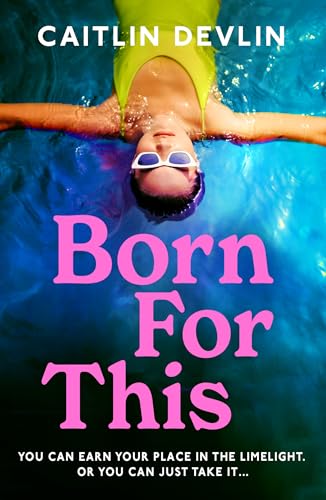
Aspiring actress Harley Roth is desperate to be as famous as her aunt Rachael, a former global movie star who became a recluse after her high-profile divorce. But even with Harley’s industry connections, she’s still stuck on the outside, waiting for her big break. So when Harley hears there may be a biopic in the works about her aunt, she jumps at the chance. After all, everyone has always told her she looks exactly like Rachael—so who better to play the part? To her surprise, Rachael welcomes Harley into her life and agrees to talk for the first time about her marriage and the mysteries surrounding it. But the movie industry is a world of ruthless ambition, underhand favours and twisted promises. After a lifetime of acting, can Harley trust that Rachael is telling her the truth? Because family ties don’t mean the same to everyone, and fame always comes at its own cost.
This is a book that I wasn’t expecting to make this list: it’s a genre that I don’t often lean towards, let alone enjoy this much. It’s about a nepo baby who decides to kickstart her career by playing her famous aunt in a biopic, presented in a dual timeline between Rachael in 90s Hollywood and Harley in present-day London. It’s about rich people acting out and having affairs and keeping secrets, and both narrators are messy, complicated characters. It’s surprisingly wonderful. The author does a great job of getting under your skin with this book, especially with the messy characters, and covers a lot of ground thematically, exploring nepotism and toxic relationships, both romantic and not, and I was once again clutching my hypothetical pearls when I caught on to the moments where Harley’s timeline brought up something I had read a chapter before in Rachael’s timeline and there were…differences in the story being told.
Atmosphere by Taylor Jenkins Reid
Selected from a pool of thousands of applicants in the summer of 1980, Joan Goodwin begins training at Houston’s Johnson Space Center, alongside an exceptional range of fellow candidates. As the new astronauts become unlikely friends and prepare for their first flights, Joan finds a passion and a love she never imagined. In this new light, Joan begins to question everything she thinks she knows about her place in the observable universe. Then, in December 1984, on mission STS-LR9, everything changes in an instant.
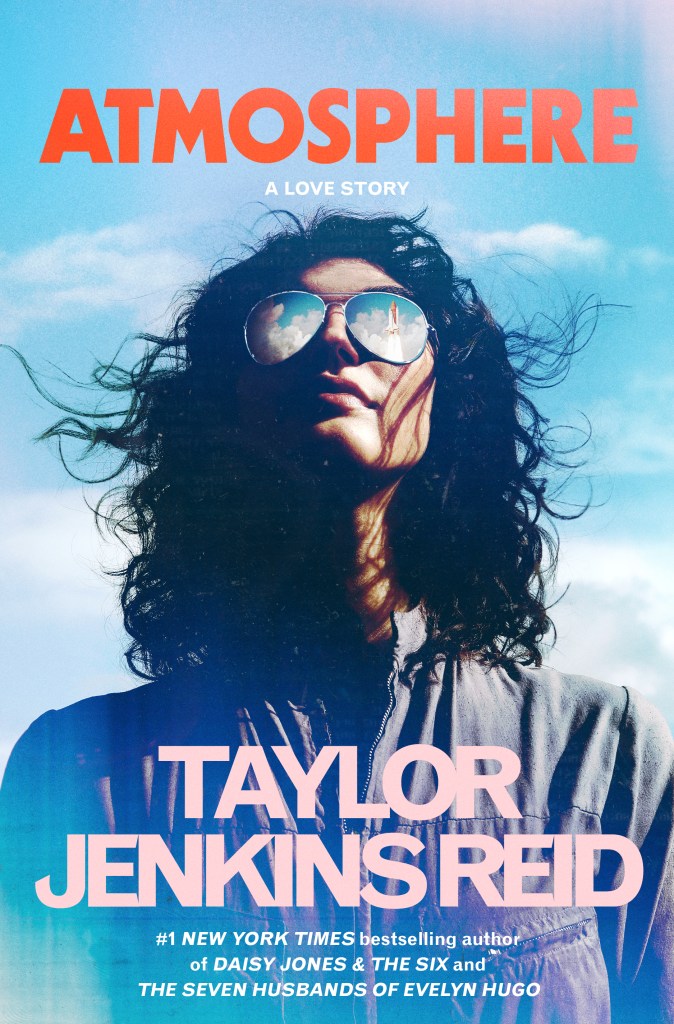
I am someone who has had a very hit-or-miss relationship with Taylor Jenkins Reid’s works in the past, and the ones I like tend to be less popular, and the ones I dislike tend to be fan favourites. I went into this book knowing that there was an above-average chance I wouldn’t enjoy it, but my love for space is so strong that my curiosity won, and I am glad that it did.
I saw another reader describe this book as heartbreak accompanied by a forehead kiss, and that is exactly what the reading experience felt like. This book is an incredibly personal and passionate story about the power of love above anything else, this time set amongst the stars. It’s fast-paced and thrilling and emotional, and also a rare occasion where I understood and appreciated every single character, whether or not I liked them. I also really loved the subplot of the love between Joan and her niece.
Into the Drowning Deep by Mira Grant
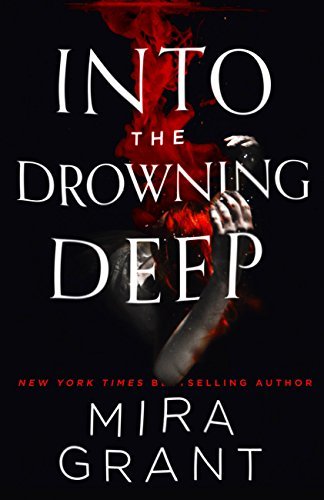
Seven years ago, the Atargatis set off on a voyage to the Mariana Trench to film a “mockumentary” bringing to life ancient sea creatures of legend. It was lost at sea with all hands. Some have called it a hoax; others have called it a maritime tragedy. Now, a new crew has been assembled. But this time they’re not out to entertain. Some seek to validate their life’s work. Some seek the greatest hunt of all. Some seek the truth. But for the ambitious young scientist Victoria Stewart, this is a voyage to uncover the fate of the sister she lost. Whatever the truth may be, it will only be found below the waves. But the secrets of the deep come with a price.
There are so many stories of mermaids sitting beautifully on rocks and not enough about them luring men to their deaths, and I’m glad this book adds to the latter category. And the mermaids (and the accompanying scientific research about them) are my favourite part of the book by far. The author has clearly done their research and writes well about the medical and science aspects of the story, and it was this belief that really sold me on the story. For a moment, I needed to believe that the mermaids could be real and not just a figment of folklore.
It’s about killer mermaids. It’s about science. It’s also about the collective failures of the human ego. It’s great.
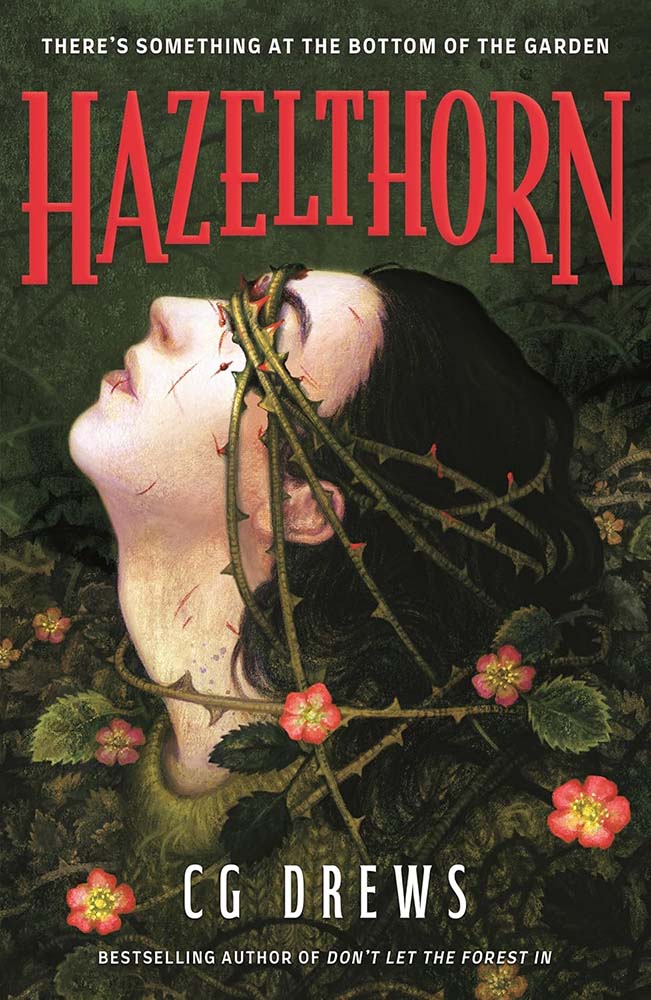
Hazelthorn by C.G. Drews
Ever since he was taken in by his reclusive billionaire guardian, Evander has lived like a ghost in the forgotten corner of the Hazelthorn estate with three ironclad rules to follow: He can never leave the estate. He can never go into the garden. And, most importantly, he can never be left alone with his guardian’s charming grandson, Laurie, who tried to kill Evander seven years ago, and yet somehow Evander is still obsessed with him. When his guardian suddenly dies, Evander inherits Hazelthorn’s immense gothic mansion and acres of sprawling grounds, along with the entirety of the family’s vast wealth. But Evander is sure that the death was actually a murder, and Laurie may be the only one who can help him find the killer before they come for Evander next. As the family’s dark secrets unravel and their bloodthirsty garden grows, Evander needs to find out what he’s really inheriting before the garden demands to be fed once more.
The thing that means the most to me about this book is that it’s intrinsically about autistic rage, and about being treated like a monster for acting autistic, and about being told that your view of the world is ‘wrong’. It includes anxiety and meltdowns and spirals and sensory issues, and a lot of the horror in the book doubles as a metaphor for what autistics go through. Hazelthorn has a similar portrayal of the raw, angry, negative autism representation that we’ve seen in Drews’ The Boy Who Steals Houses trilogy, and it’s still a breath of fresh air to experience.
Hazelthorn is ultimately a love letter to grief, to coming to terms with the complexities of finding out who you truly are when you’ve been cut off from most defining experiences, and the dichotomy of warmth and brutality that I love about Drews’ works. It pays tribute to former weird little children who lived in their daydreams, and there’s something about the author’s horror works that makes me feel as if I’m going to come back to them again and again. Hazelthorn will leave you breathless and hesitant to venture deeper into the garden.
The Everlasting by Alix E. Harrow
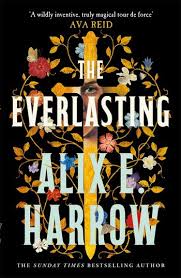
Sir Una Everlasting was Dominion’s greatest hero: the orphaned young girl who became a knight and died for queen and country. Her legend lives on in songs and stories, in children’s books and recruiting posters―but her life, as it truly happened, has been forgotten. Centuries later, Owen Mallory―failed soldier, struggling scholar―falls in love with the tale of Una Everlasting. Her story takes him to war, to the archives, and then into the past itself. Una and Owen are tangled together in time, bound to retell the same story over and over again, no matter what it costs. But that story always ends the same way. If they want to rewrite Una’s legend, they’ll have to rewrite history itself.
This one hurt, as do any stories about stories for me. There’s something about the cyclical nature of being thrown around in time to watch the making of a legend by virtue of her unmaking. This story doesn’t just tell a legend—it dissects it, rewrites it, and dares to ask what key elements go missing in the stories we love. I loved the way Harrow constructed this narrative surrounding legends and idols and how those stories are shaped. She approached the idea from the angle of how myths shape the world over time, leaning into the idea that history is written by the victor. It’s about the flow of time and what happens when you disrupt or try to take power over the narrative of history.
The Everlasting feels like a fairytale, like folklore, and it’s one of my favourite reads of the year. It’s melancholic and romantic, funny at times, unflinching in challenging gender norms, and full of yearning and observations about the world that apply to both fantasy and the world we live in. At the end of it all, this book is about love. Enduring and everlasting love.

 TandeWrites
Leave a comment